
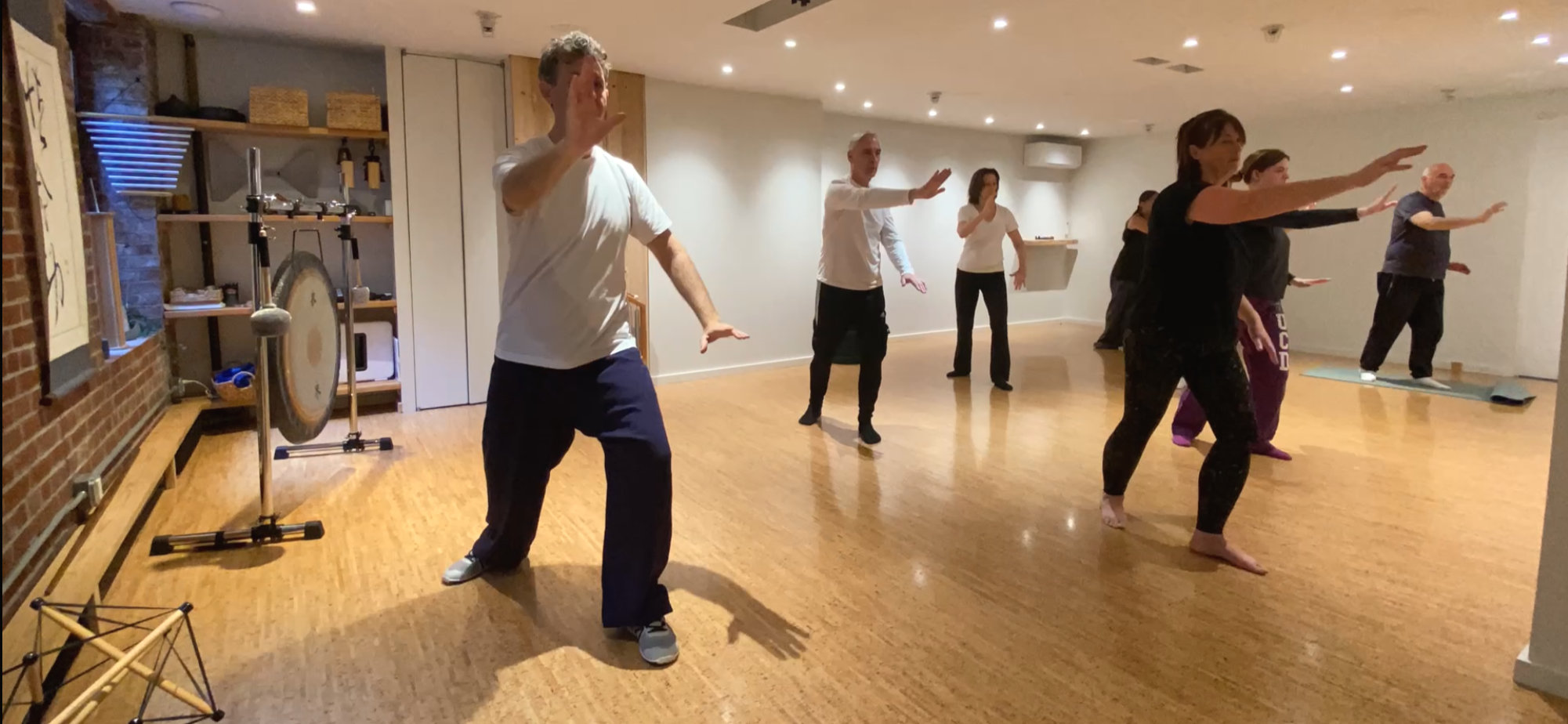
The Foundation Problem: Why Posture, Breathing, and Body Mechanics Come First
There's a conversation I find myself having more than any other, and it usually starts with someone describing something they've been living with for a while.
Back pain that won't go away or neck issues that have become the baseline. Headaches that show up reliably, or low energy, or a kind of anxiety in the nervous system that doesn't have a clear cause.
And somewhere in that conversation, we get to the part where they list off the things they've already tried.
I'm not here to criticize any of those things, but I do want to offer a different lens, one that comes from over a decade of teaching, a lifetime of living in a body that used to be in serious discomfort, and a training in Chinese medicine that keeps pointing me back to the same place.
The foundation comes first.
What I Mean by Foundation
When I say foundation, I mean three specific things - body mechanics, breathing mechanics, and posture. These are not separate categories. They're one system, and when that system is working well, it tends to work quietly, invisibly, in the background. When it's not working, it tends to show itself in the form of exactly the symptoms we're trying to get out of.
Chronic musculoskeletal problems, back, neck, shoulder, elbow, wrist, these don't usually come from a single moment of injury (though they can start there). More often, they're the accumulated result of patterns that have been running for years. Patterns of how we stand, sit, carry ourselves, breathe, and hold tension. The body is an extraordinarily adaptive system, and it will accommodate a lot before it starts complaining. But eventually it does complain, and that complaint is the signal that the pattern has gone as far as it can go.
The same is true for what might look like neurological or systemic issues. Headaches, low energy, difficulty concentrating, anxiety without a clear psychological trigger, these can often be traced, at least in part, to disruptions in the body's basic regulatory systems, the breath, the nervous system, the musculoskeletal relationships that support or compromise both.
My teacher, Tom Bisio, describes a principle that shows up again and again- joint alignment and efficient structure determine how the body distributes load. Joints that are stacked properly share that load across the whole system. Joints that are chronically out of alignment accumulate local irritation. And over time, that local irritation compounds. You can strengthen around it, stretch around it, treat it temporarily, but until the pattern underneath changes, you're working on the surface of a deeper issue.
Why the Practice Is the Answer (But Not in the Way You Think)
Here's where people sometimes expect me to say come to class twice a week and you'll be fine.
That's not what I'm going to say.
Yes, the practices we work with in Ba Gua Zhang, Qi Gong, and Nei Gong are the most efficient (and FUN!) tools I know for restoring and maintaining this kind of foundational health. They were no doubt developed for this reason, not as fitness programs, not primarily as martial arts, but as systems for cultivating the body's natural regulatory capacity, its ability to find alignment, breathe properly, move efficiently, and self correct.
But the practice isn't only what happens during training.
Tom also makes a point that I find myself referencing constantly…
Skills developed in mindful practice carry into daily life. The nervous system re-patterns through relaxed, focused attention applied consistently. And consistency, here, doesn't mean frequency of formal training. It means the quality of attention brought to the body across the whole day.
This is actually the key thing. Of course the forms and sets you practice matter. BUT, the way you sit at your desk or how you move/stand at your job for the next eight hours matters more.
The Checking In Practice
The internal arts have a specific orientation toward daily self-regulation that I keep coming back to. The idea isn't that you have to be in a formal practice posture to be practicing. The idea is that you're developing a quality of internal listening that eventually runs continuously, like a thread that weaves through everything you do.
In practical terms, this looks like checking in.
How am I holding my jaw right now?
Where are my shoulders relative to my ears?
Is there weight in my feet, or am I floating up into my chest?
Am I actually breathing, or have I been holding a shallow half breath for the last twenty minutes??
I realize these questions sound almost embarrassingly simple. But the consistent practice of asking them, and actually pausing to feel the answer instead of just thinking about it, is exactly how a new pattern gets installed into your system. At first it’s a little tedious and you forget for hours and then remember. You set alarms for yourself or put notes on your refrigerator. And then slowly, you forget less. The checking in starts to happen on its own and eventually it runs quietly in the background, like software you don’t have to consciously operate.
That's the goal and ANYONE can do it!
That's what cultivating awareness means. Not a state you visit during practice but more of a quality you carry with you.
Why This Has to Come First
I want to be direct about something, because I think it matters.
If you are dealing with a chronic condition, whether musculoskeletal or systemic, and you're trying to figure out what to prioritize, I have a hard time making the case for anything that doesn't start here.
Outside interventions, whether medical, therapeutic, or otherwise, can absolutely have a role. I'm not dismissing any of that. But if the foundation is still broken, if the pattern that produced the symptoms is still running, then you're largely in the business of managing the downstream effects of a problem that hasn't been addressed.
This is like continuously mopping up the puddle left by the crack in the roof without ever addressing the crack.
These Chinese and Eastern traditions understood this. The classics describe health as a state of natural self-regulation, a condition in which the body's systems are in dynamic communication with each other and with the environment. Disease, in this view, is what happens when that self-regulation breaks down, when the body loses the thread back to its own natural organization.
The internal arts and their associated practices and rituals exist to restore that thread.
This puts the responsibility exactly where it belongs… inside the person, in the quality of attention and consistency they bring to their own body, day after day.
What This Looks Like in Practice
In the Qi Gong and Nei Gong work we practice, the instruction is always to develop ease in the structure first. Not strength, not flexibility, not impressive range of motion. Ease. The joints find their natural alignment, the breath deepens, the nervous system begins to settle, and from that settled state, re-patterning can happen.
This is different from most approaches because it's not doing more. It's getting quiet enough to hear what's already there, and then correcting it.
The checking-in practice supports this. So does showing up to class or sessions consistently. So does the attention you bring to how you carry groceries, how you sit in traffic, how you breathe when you're on a call that's irritating you.
All of it is the practice. All of it either reinforces the pattern you're trying to change or starts laying down a new one.
The Honest Pitch
If any of what I've described matches your experience, whether you've been living with something for months or years, or you're starting to notice early signals you'd rather not ignore, the most useful thing I can offer is this - the foundation is workable. Bodies that have been running a dysfunction for a long time can and do re-pattern. It takes time, attention, and consistency, but the tools are real, they're old, and they work.
If you want to start somewhere, class is a good place. Private sessions go faster and deeper. And the checking-in practice you can start today, no class required.
Jonathan Breshin is the founder of Root of Movement Internal Arts, teaching Ba Gua Zhang, Qi Gong, Nei Gong and Tai Chi in New York City. Root of Movement classes are held weekly in NYC.
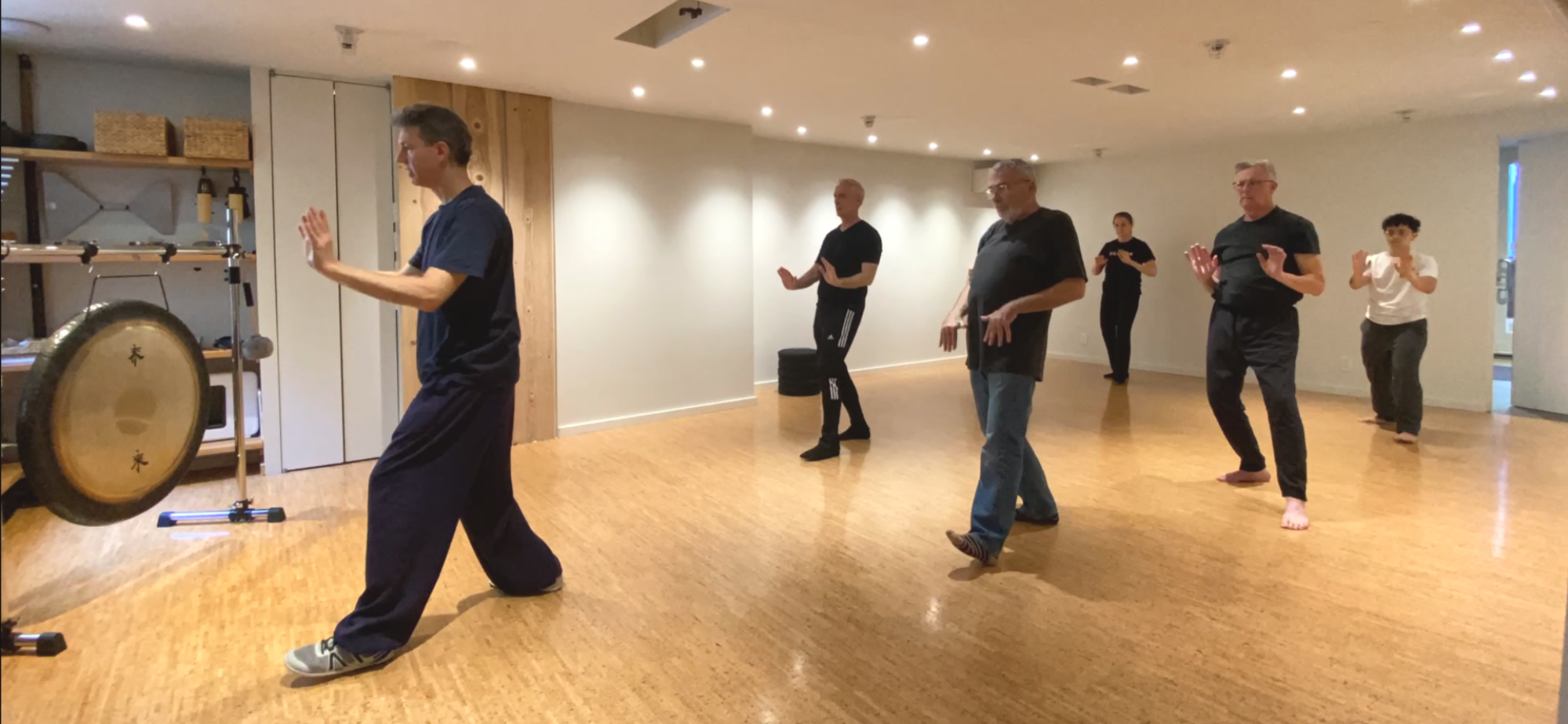
What You Learn in Tai Chi, Qigong, and Ba Gua Is Already Happening in Your Kitchen
There's a moment that happens for a lot of people somewhere in the middle of training.
They're working on something like a transition, a breathing pattern or a way of organizing their weight, and then later that day they're carrying groceries up a flight of stairs, or reaching for something overhead, or just standing in line at the coffee shop, and something feels different. Not dramatically different, just quieter, more organized and more like themselves.
They weren't thinking about it, it just happens.
That's the whole point from my perspective.
Internal arts training, whether that's Tai Chi, Qi Gong, Ba Gua Zhang, or Nei Gong, can look pretty esoteric from the outside. Slow movement, circle walking, standing still for long stretches of time. To someone who hasn't experienced it, it can seem like a nice way to relax, maybe a gentle workout for older folks.
But that's not what it is.
What you're actually developing is a set of universal principles. How to move with your structure behind you. How to breathe in a way that supports what your body is doing instead of working against it. How to feel what's happening inside you, and make a small adjustment before it turns into a bigger problem. How to be still inside while everything outside keeps moving.
And those principles don't just apply to practice, they’re applied everywhere.
The Practice Is a Laboratory
Think of your training time as a laboratory for understanding how your body actually works. Not how you think it works, and not how you've been told it works, but how it actually functions when you're paying close attention to it.
In that laboratory, you start taking readings. You notice where you're holding tension that you didn't know was there. You notice where your breath stops, or gets shallow, or disappears entirely when you concentrate. You notice that your left side and your right side have completely different opinions about what balanced feels like.
This is the work. And it's absolutely fascinating once you get into it.
The reason it translates so directly into daily life is that the things you're studying in class, alignment, breath, coordination, relaxed power, how your body moves as an integrated whole rather than a collection of parts, these are not special-occasion skills. These are the fundamental operating conditions of being a human being. You use them every day whether you're paying attention to them or not.
The practice just makes them visible.
The Body as a Building Worth Attending To
I spent years working as an operating engineer, helping maintain a building in Times Square. Half a million square feet of boilers, chillers, electrical systems, air handling, plumbing, etc. The job was to check pressures, temperatures, flow rates, equipment conditions, so that problems could be noticed early and addressed before they became emergencies.
That level of attention was considered completely normal and necessary. You wouldn't run a building that size without it.
So here's the question, if a building warrants that kind of care and monitoring, what about a human body?
A building can be replaced, your body cannot.
Most of us were never taught how to take our own readings. We were given a body, pointed in a direction, and told to go. We learn to manage symptoms when they get bad enough, but we're rarely taught to notice what's actually happening inside, and to respond before things become a crisis.
That's a significant gap and internal arts practice is the most effective way to start closing it.
What Changes When the Practice Starts Traveling
Here's what it actually looks like when the practice starts showing up outside the practice.
You're at your desk for three hours and you notice, without anyone prompting you, that your shoulders have crept up toward your ears and your breath has gotten tight. You take a breath, you let the shoulders drop, you feel your feet on the floor and you adjust.
That's it. That's the practice right there, in your office, at 2 in the afternoon.
Or you're picking something heavy up off the floor, and instead of rounding your back and muscling through it, something in you knows how to organize the movement differently. You root your feet, you let the structure of your body do the work, and the thing comes up easily without strain and no drama.
Or you're in a difficult conversation, and instead of getting flooded and reactive, there's a little bit more space inside you. A quality of stillness that isn't the same as being shut down. You're present, but you're not drowning in it.
These aren't small things. They're the texture of an ordinary day, but going better.
Why the Simple Stuff Contains the Deep Stuff
One of the most consistent surprises for people in this work is discovering that the simple practices contain the same principles as the complex ones. A breathing exercise is not a warm up for the real work. It is the real work, approached at a particular scale.
In Ba Gua, circle walking looks like the most basic thing imaginable. You're just walking in a circle, but the same principles governing how you walk that circle govern everything else. The forms, the applications, the way you move through a crowded subway platform. Everything operates according to the same underlying logic.
That's what makes this kind of training fractal. You can find the same truths at the smallest scale and express them at increasingly sophisticated levels. The breath teaches you something. The posture teaches you the same thing in a different way. The form teaches it again. Your kitchen teaches it again, IF you're paying attention while you cook!
The practice isn’t a separate world you enter and then leave. It's a way of understanding the world you're already in.
Boom!
You Are the Pilot
Here's the way I think about it. You are the operator of your own body, not a passenger, not a bystander watching things happen to you. The actual pilot!
Most of us, through no fault of our own, were never given much of an instruction manual. So we fly by intuition and habit, which works until it doesn't, and then we hand the controls to someone else and hope they can sort it out.
What these practices give you, gradually and through direct experience, is a deeper and more functional relationship with how you actually work. You start to know yourself in a more practical way and that knowledge compounds over time.
It’s absolutely amazing!
It shows up in how you move, how you breathe, in how you handle stress, manage pain, recover from hard days, and navigate the ordinary demands of a life. It shows up in how you age.
That's not a small return on the investment of learning how to stand and breathe and walk in a circle.
Where to Start
You don't need to already be in good shape. You don't need a background in martial arts or Chinese medicine or anything like that. Most people who come to this work come because something hurts, or because they're tired in a way that sleep doesn't fix, or because they have a feeling there's something they're missing about how to take care of themselves.
That's enough and it’s a perfect place to start.
The foundational practices, breathing, basic alignment, joint mobility, simple movement and self-care work, are totally useful on their own. Not as a preview of the real thing, but as real things in themselves. And the deeper you go, the more those simple foundations reveal.
If you're in New York and you want to experience this in person, book a class here. If you're not local, there's more to come online. And if something specific is going on with your body and you want a more direct conversation about it, private session are always available.
The practice is ready when you are.
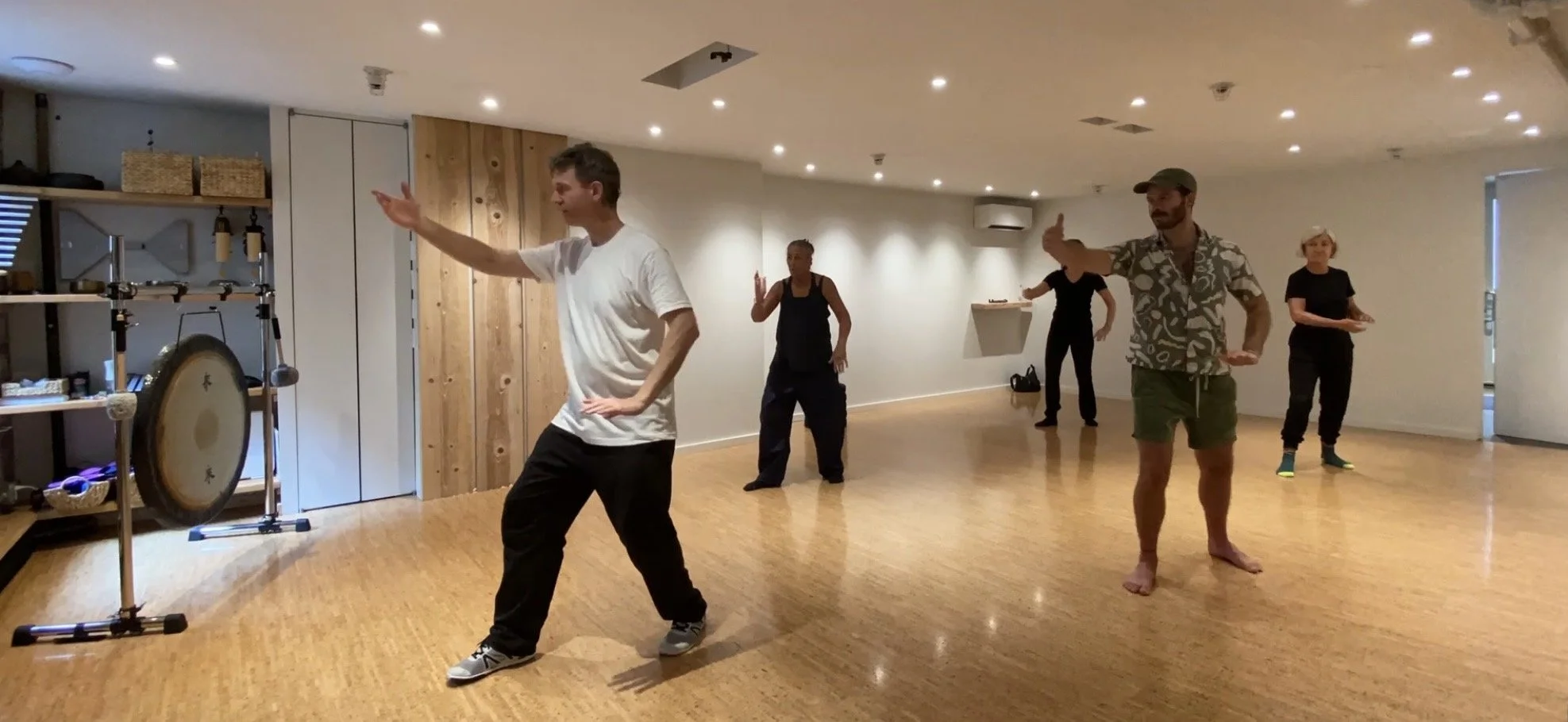
Function Over Form: What Your Walk Reveals About Your Health
There's something you can learn about a person just by watching them cross the street.
Not their posture or whether their spine looks perfectly stacked or their shoulders are squared.
What you're actually watching for is whether the whole thing moves together, whether there's a quiet rhythm to it, a coordination that happens without them thinking about it.
Some people have it, even if their structure looks far from perfect on paper. And some people don't, even though they look completely fine standing still.
That gap, between how the body looks and how the body actually works, is at the heart of what these ancient Chinese practices like Qi Gong, Ba Gua and Tai Chi are designed to address.
The Insight That Changes Everything
I've been spending time recently assisting at an acupuncture clinic upstate, working alongside a colleague who has been in clinical practice for close to two decades. We're treating patients back to back with acupuncture, Tui Na, Qi Gong, herbs, and qi gong exercises sent home with people as their physical therapy homework. It's a busy, thriving practice, and watching him work is amazing.
At one point during a session, he said something to a patient that stopped me mid-thought.
Function over form.
Three words. And they cut through about ninety percent of the confusion people carry about their bodies, about pain, about why certain things have stopped working the way they used to.
We've been conditioned, by fitness culture, by medicine, even by the way we talk about the body, to measure health by how things look. If a spine looks straight, it must be healthy. If posture looks good, the body must be working well. If an injury looks healed on an MRI, the problem must be gone.
But the body doesn't actually work that way, and these practices have always known it.
What My Teacher Tom Bisio Teaches About Integration
Tom Bisio, whose work sits at the foundation of everything I teach, addresses this directly in A Tooth from the Tiger's Mouth.
When he talks about recovering from injury, the goal isn't simply getting a body part to look right again, it's getting it to function in harmony with the rest of the body.
He makes the observation that injuries often create a break in the connection between the injured area and the whole. An injured knee becomes "my bad knee," something separate, something other. And that separation, even after the tissue heals, is where dysfunction lives.
Real recovery, real rehabilitation, stops that separation and it restores integration.
That's a fundamentally different way of thinking about the body than most people are used to. It's not about fixing a part- It's about restoring the whole.
This’s exactly why Qi Gong, Nei Gong, Tai Chi and Ba Gua Zhang take the approach they do.
Instead of simply targeting individual muscles or correcting isolated structural problems, these arts work to restore the inner coordination that should be running quietly in the background every time you move.
In one of Toms programs, Tian Gan Nei Gong he teaches that physical therapy and massage can relieve pain and restore movement potential, but they often don't restore the neuro-muscular wiring that generates proper internal movement. Without that restoration, some of the dysfunction remains.
This can go on for a lifetime, and often does.
Your Gait Is a Window Into Everything
Of all the ways to observe whether that integration is actually happening, gait, the simple act of walking, is one of the clearest.
Think about what a single step is supposed to involve. When the body is working correctly, a step isn't just a foot touching the ground. The whole spine rotates gently with each stride. The tissues breathe, blood and fluids move through areas that would otherwise stagnate, circulation reaches into the corners of the body that sitting all day has cut off.
There is, when everything is communicating, a symphony of movement that unfolds with every step, and you don't have to think about it at all.
But when that integration breaks down, whether from old injury, chronic tension, years of compensatory patterns, or simply from the disconnected way most of us have learned to live in our bodies, the step becomes mechanical. Parts move, but the whole doesn't.
You can see it, and more importantly, you can feel it.
What Ba Gua Zhang Research Actually Shows
In The Art of Ba Gua Zhang, Tom cites research comparing longtime Ba Gua practitioners to healthy non-practitioners doing the same exercise. Twelve minutes of quick walking.
The results were impressive. The Ba Gua group walked faster, with lower heart rates and lower blood pressure. Not because they were more fit in the conventional sense, but because decades of practice had cultivated a different quality of movement at the deepest level.
The research also found that Ba Gua circle walking burns significantly more calories than normal walking, because the rotational, spiral nature of the movement engages the entire body in a way that ordinary linear walking just doesn't.
Tom also describes how the slow, deliberate Mud Walking Step of Ba Gua (similar to Tai Chi walking) practice fully engages the body in controlling weight shifts from foot to foot, aligning the joints of the lower leg, and forging a connection all the way up through the body's energy centers in the Dantian and Mingmen (the lower basin of the torso.)
The body isn't just moving, it's communicating with itself.
That's function from the inside out.
Why Form So Often Follows Function (Not the Other Way Around)
Here's the thing that surprises people when they first start working with these practices..
You don't need your body to already look a certain way to benefit. You don't need perfect posture going in. You don't need a structurally ideal body, or a clean bill of health, or anything resembling what "correct" is supposed to look like.
What the internal arts work on is the restoration of coordination, of inner communication, of the self-organizing intelligence the body has always had access to.
Through self-observation, through breath, through the kind of relaxed, focused attention that Qi Gong and Nei Gong cultivate, the body begins finding its way back. Not because you forced it into the right shape, but because you gave it the conditions to remember how to work.
As an example, the Tian Gan Nei Gong system works specifically with the natural spiral movement patterns that run throughout the body. Injury and aging can reduce or even eliminate these spirals, leading to dysfunctional movement that both creates and maintains patterns of pain, reduced flexibility, and reduced range of motion. Tian Gan exercises restore those patterns, not by overriding the body, but by teaching it to move correctly again, from the inside.
And when function returns, form often follows on its own.
Posture improves because the body is actually integrated, not because someone told it to stand up straight. The gait becomes fluid because the whole system is communicating, not because any single part was corrected. The symphony returns.
This Is Original Functional Medicine
There's a lot of talk today about "functional medicine," and most of it is fine. But the principles these Chinese arts operate on are the original version, refined over centuries of clinical observation and practice. The idea that the body is an organic whole, that no part can truly be treated in isolation from the rest, that restoring function is both the goal and the measure of health, none of that is new. It's just that we drifted away from it.
Watching patients move through that upstate clinic and the people I work with in my classes and teaching one on one, watching them arrive guarded and leave lighter, watching the body respond to intelligent, integrated care, it's a reminder of what these practices have always been about. Not perfection or performance but function.
If something isn't working the way it should, the question isn't always what does it look like? The better question is, is it connected? Is it communicating? Is the whole thing moving together?
Start Working With This
If any of this is ringing true, the good news is you don't have to wait until something breaks down to start. Qi Gong, Nei Gong, Ba Gua Zhang and Tai Chi are all accessible practices that meet you where you are and build from there.
My classes at in Greenwich Village, New York City are a good place to begin. Private sessions are also available if you want more personalized attention.
Jonathan is the founder of Root of Movement Internal Arts and teaches Ba Gua Zhang, Qi Gong, and Internal Martial Arts at The Qi Center in New York City. He studied under Tom Bisio, whose books A Tooth from the Tiger's Mouth and The Art of Ba Gua Zhang are cited throughout this post.
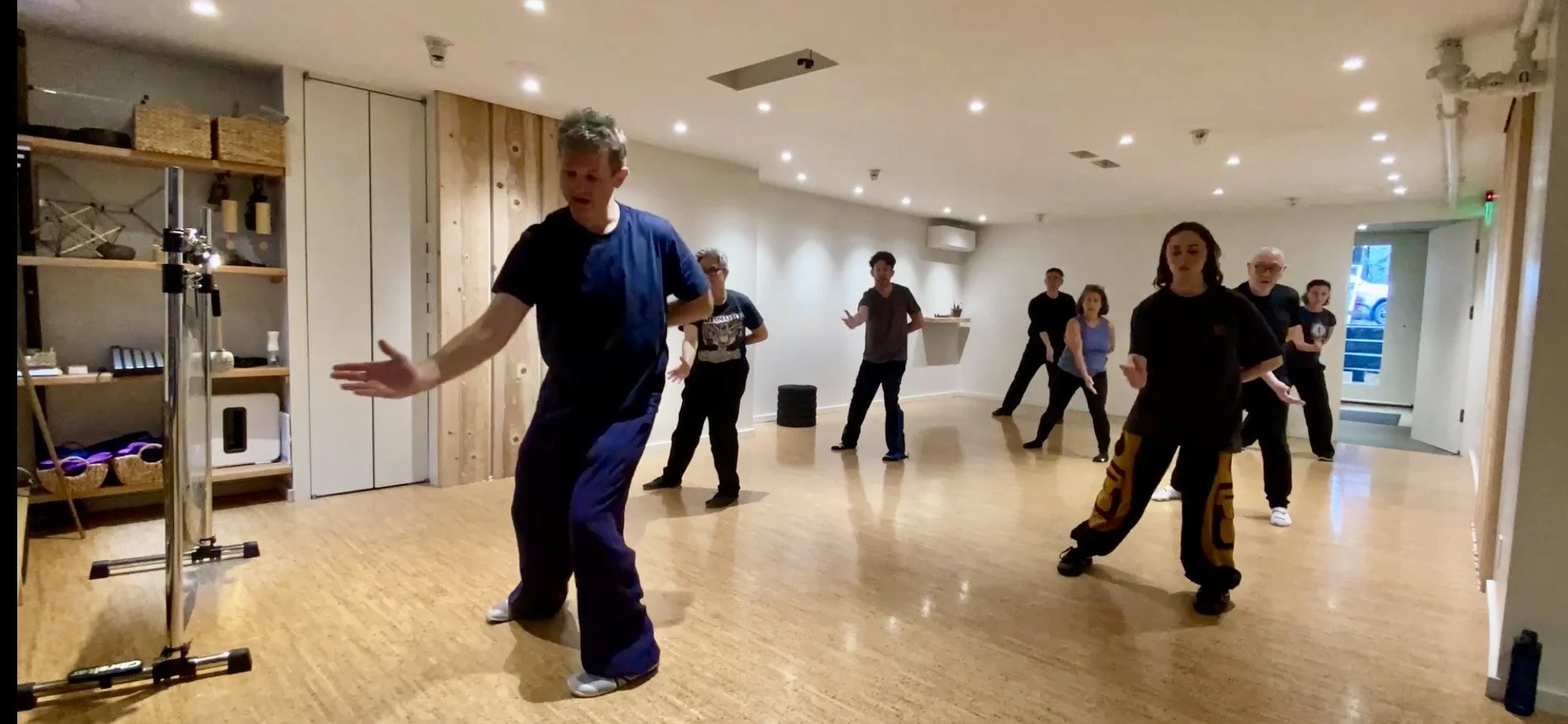
The Intelligence You've Been Trained to Ignore (And How to Get It Back)
We spend years in school learning to think, analyze, reason, and problem-solve, and those are clearly useful skills. But there's another kind of intelligence that never made it onto the curriculum, and most of us have spent our entire lives quietly overriding it.
Your body is constantly reading the world around you and sending you information..
Subtle signals, clear sensations, even warnings that arrive well before the analytical mind catches up. I know you've felt it before, even if you didn't have a name for it. Knowing something was wrong before you could explain why. Sensing that a situation was off before any visible evidence confirmed it. That quiet pull toward or away from something that you talked yourself out of because you couldn't justify it logically.
That's not imagination. That's a real, sophisticated sensing system doing exactly what it was built to do.
The problem isn't that the body stopped communicating. The problem is that we stopped, or, more accurately, were never formally taught how, to listen.
What the Body Is Actually Doing
Modern research on the fascial network has made something very clear that ancient practitioners mapped out centuries ago. In my teachers program, Tian Gan Nei Gong by, Tom Bisio, he talks about the foundational research on fascia and internal martial arts, explains it this way - fascia is largely innervated by proprioceptive nerves. That means proprioception, our ability to sense the position of the body in space and to feel what's happening internally, is primarily a fascial function, not a muscular one.
In other words, your body has a built-in sensing system that is woven into every layer of tissue, every organ, every movement pattern. It is constantly gathering information and sending it upward. The question isn't whether the signal is there. The question is whether anyone is on the receiving end.
Practices like Ba Gua Zhang, Tai Chi, Qi Gong and Nei Gong work directly with this system.
The Qi Gong principle of "The Mind in Motion," as described in Qi Gong: A Functional Path to Health and Longevity, is about using relaxed concentration to re-pattern the nervous system and the musculoskeletal link, and the skills developed in practice carry into daily life.
That's not a side effect. That's the whole point!
What the Tradition Has Always Known
In my teachers other book, A Tooth from the Tiger's Mouth, there's a passage that puts the whole thing in simple terms. Tom writes that we all know how to eat properly, but we've forgotten how to trust our own instincts. We've become separated from our common sense.
He was writing specifically about nutrition, but that observation reaches a lot further than the dinner table. We've outsourced our inner knowing to external validators like experts, metrics, second opinions, and endless research, and in the process, we've let the quieter intelligence go largely unheard. It's not that the instinct disappeared. It's that we stopped giving it any airtime.
What Ba Gua Zhang, Tai Chi, Qi Gong and Nei Gong work on, in a very real and practical way, is the reconnection to what the internal arts calls the Original Mind… the inner knowing that lives outside of analytical thinking.
These practices don't pile more information on top of what you already have. They remove interference so you can hear what was always there.
In the Tian Gan Nei Gong program from Tom, he says the practice asks you to "cultivate an attitude of gently suggesting to yourself where the sensing and observing take place, and then relax the Mind-Intention and let it observe, listen and sense." Not force it. Not manufacture it. Not analyze what comes up. Just allow. That runs completely opposite to how most of us were trained to function, and it is precisely why it works.
The way of the tao is to allow. Not try!
Why This Matters More Now Than Ever
The constant onslaught of information, messaging, noise, and opinion that we all navigate every single day has made this harder than it's ever been. We’re flooded with signals from outside while the signals from inside get buried further and further down.
This is one of the reasons I feel like what we practice is genuinely needed right now, not as a wellness trend or a stress management technique, but as a real skill - the ability to turn attention inward and actually hear something useful.
What This Looks Like in Practice
In class, the reconnection shows up in concrete and sometimes surprising ways. People start noticing things they'd been walking right past. Things like tension that had become so familiar it felt like their natural resting state, breath patterns that were quietly winding them up, signals the body had been sending for years without anyone on the receiving end.
It’s not relegated to just practice, either. Over time, decisions get cleaner, the constant second-guessing starts to soften and people stop overriding what they already sense and start trusting it instead.
That intelligence was never gone, it just needed someone to get quiet enough to hear it.
How to Begin
You don't have to overhaul your life to start reconnecting. A few things that help immediately..
Move with attention, not ambition. Even a short daily Qi Gong practice done with genuine internal focus is worth more than a high-intensity workout where the mind is somewhere else entirely.
Stop asking what it's supposed to feel like. In class, I'll sometimes pause and ask someone, "How does that feel?" and they'll look around for the right answer. There is no right answer. Start with what's actually happening, not what you think should be happening.
Pause before you analyze. The next time you're making a decision, check in with your body first. What's the physical sensation? Contraction or expansion? Ease or resistance? You don't have to act on it blindly, but at least let it speak.
These practices have been cultivating this kind of intelligence in people for generations of people. The body isn't just a vehicle for the mind. It's a sophisticated sensing system in its own right, and most of us have just stopped listening.
If you're ready to start working with it, class is a good place to begin. We meet weekly in New York City. Private 1-on-1 sessions are also available for more personalized attention in person or online.
Come check it out and see for yourself.