
The Intelligence You've Been Trained to Ignore (And How to Get It Back)
We spend years in school learning to think, analyze, reason, and problem-solve, and those are clearly useful skills. But there's another kind of intelligence that never made it onto the curriculum, and most of us have spent our entire lives quietly overriding it.
Your body is constantly reading the world around you and sending you information..
Subtle signals, clear sensations, even warnings that arrive well before the analytical mind catches up. I know you've felt it before, even if you didn't have a name for it. Knowing something was wrong before you could explain why. Sensing that a situation was off before any visible evidence confirmed it. That quiet pull toward or away from something that you talked yourself out of because you couldn't justify it logically.
That's not imagination. That's a real, sophisticated sensing system doing exactly what it was built to do.
The problem isn't that the body stopped communicating. The problem is that we stopped, or, more accurately, were never formally taught how, to listen.
What the Body Is Actually Doing
Modern research on the fascial network has made something very clear that ancient practitioners mapped out centuries ago. In my teachers program, Tian Gan Nei Gong by, Tom Bisio, he talks about the foundational research on fascia and internal martial arts, explains it this way - fascia is largely innervated by proprioceptive nerves. That means proprioception, our ability to sense the position of the body in space and to feel what's happening internally, is primarily a fascial function, not a muscular one.
In other words, your body has a built-in sensing system that is woven into every layer of tissue, every organ, every movement pattern. It is constantly gathering information and sending it upward. The question isn't whether the signal is there. The question is whether anyone is on the receiving end.
Practices like Ba Gua Zhang, Tai Chi, Qi Gong and Nei Gong work directly with this system.
The Qi Gong principle of "The Mind in Motion," as described in Qi Gong: A Functional Path to Health and Longevity, is about using relaxed concentration to re-pattern the nervous system and the musculoskeletal link, and the skills developed in practice carry into daily life.
That's not a side effect. That's the whole point!
What the Tradition Has Always Known
In my teachers other book, A Tooth from the Tiger's Mouth, there's a passage that puts the whole thing in simple terms. Tom writes that we all know how to eat properly, but we've forgotten how to trust our own instincts. We've become separated from our common sense.
He was writing specifically about nutrition, but that observation reaches a lot further than the dinner table. We've outsourced our inner knowing to external validators like experts, metrics, second opinions, and endless research, and in the process, we've let the quieter intelligence go largely unheard. It's not that the instinct disappeared. It's that we stopped giving it any airtime.
What Ba Gua Zhang, Tai Chi, Qi Gong and Nei Gong work on, in a very real and practical way, is the reconnection to what the internal arts calls the Original Mind… the inner knowing that lives outside of analytical thinking.
These practices don't pile more information on top of what you already have. They remove interference so you can hear what was always there.
In the Tian Gan Nei Gong program from Tom, he says the practice asks you to "cultivate an attitude of gently suggesting to yourself where the sensing and observing take place, and then relax the Mind-Intention and let it observe, listen and sense." Not force it. Not manufacture it. Not analyze what comes up. Just allow. That runs completely opposite to how most of us were trained to function, and it is precisely why it works.
The way of the tao is to allow. Not try!
Why This Matters More Now Than Ever
The constant onslaught of information, messaging, noise, and opinion that we all navigate every single day has made this harder than it's ever been. We’re flooded with signals from outside while the signals from inside get buried further and further down.
This is one of the reasons I feel like what we practice is genuinely needed right now, not as a wellness trend or a stress management technique, but as a real skill - the ability to turn attention inward and actually hear something useful.
What This Looks Like in Practice
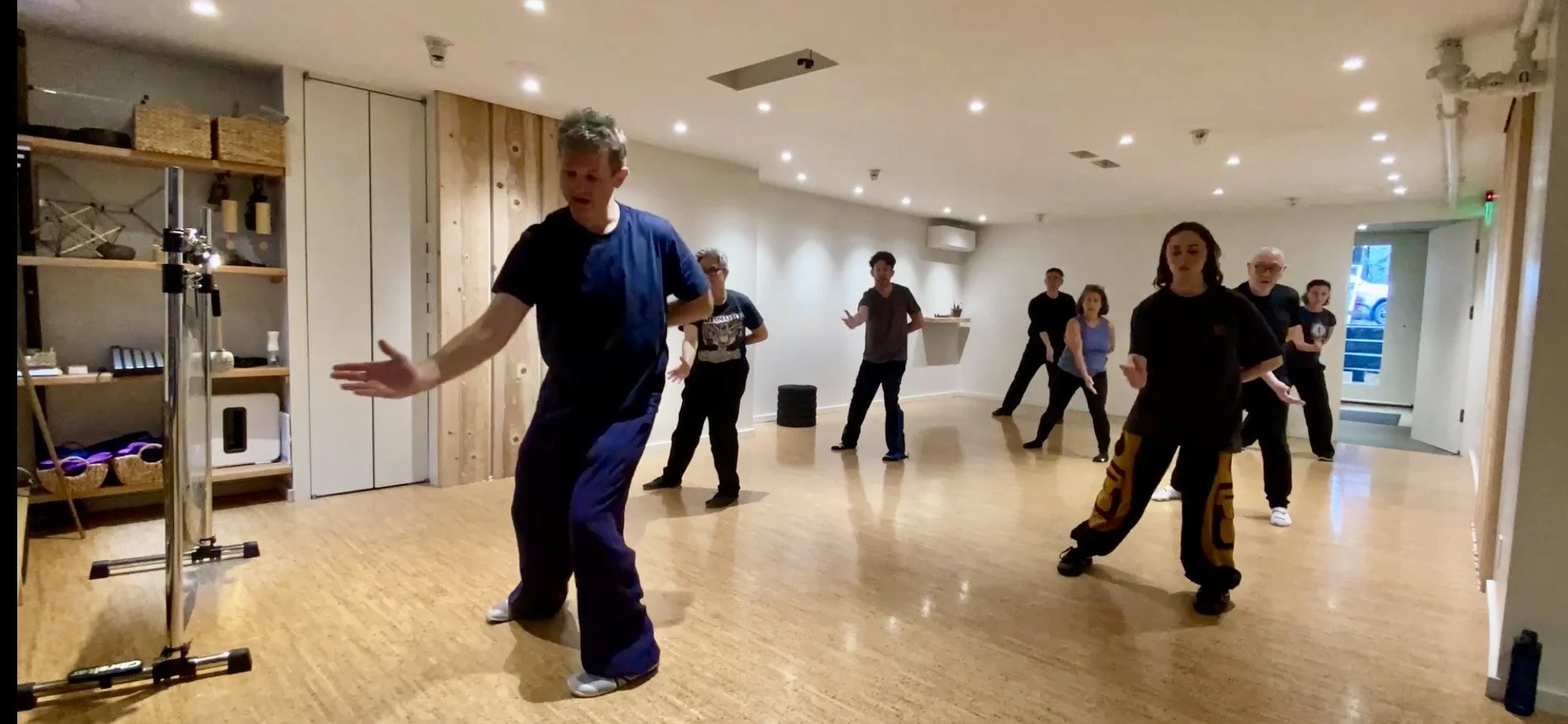
In class, the reconnection shows up in concrete and sometimes surprising ways. People start noticing things they'd been walking right past. Things like tension that had become so familiar it felt like their natural resting state, breath patterns that were quietly winding them up, signals the body had been sending for years without anyone on the receiving end.
It’s not relegated to just practice, either. Over time, decisions get cleaner, the constant second-guessing starts to soften and people stop overriding what they already sense and start trusting it instead.
That intelligence was never gone, it just needed someone to get quiet enough to hear it.
How to Begin
You don't have to overhaul your life to start reconnecting. A few things that help immediately..
Move with attention, not ambition. Even a short daily Qi Gong practice done with genuine internal focus is worth more than a high-intensity workout where the mind is somewhere else entirely.
Stop asking what it's supposed to feel like. In class, I'll sometimes pause and ask someone, "How does that feel?" and they'll look around for the right answer. There is no right answer. Start with what's actually happening, not what you think should be happening.
Pause before you analyze. The next time you're making a decision, check in with your body first. What's the physical sensation? Contraction or expansion? Ease or resistance? You don't have to act on it blindly, but at least let it speak.
These practices have been cultivating this kind of intelligence in people for generations of people. The body isn't just a vehicle for the mind. It's a sophisticated sensing system in its own right, and most of us have just stopped listening.
If you're ready to start working with it, class is a good place to begin. We meet weekly in New York City. Private 1-on-1 sessions are also available for more personalized attention in person or online.
Come check it out and see for yourself.
How Posture, Movement, and Breath Affect Your Body, a Beginner's Guide to Qi Gong & Nei Gong
I want to talk about something that I think gets overlooked way too often. How you carry yourself through this world is pretty much the foundation of everything. How you feel day to day, how your body functions, and honestly what you're even capable of doing.
If you've ever wondered whether practices like Qi Gong or Nei Gong could actually help you feel better in your body, this is for you.
And you don't need any experience to start!
You're Not Broken, You Might Just Be Disconnected
Here's the thing that took me a long time to really understand…
Posture and movement and breath aren't things you practice for thirty minutes and then stop and go on with your day.
They're things you're already doing all day long whether you're thinking about them or not.
You're standing, you're moving, you're breathing, every single moment, so the question I like to ask is this.
What if instead of treating your body like it's broken and needs to be fixed in some appointment once a week, you started to see that you're not broken at all.
You're likely just a little disconnected, and the good news is that connection can be relearned.
What Makes These Practices Different
What I teach comes from Traditional Chinese Martial Arts and Chinese Medicine.
One of the things that drew me to these practices in the first place is that they're principle based.
Meaning you're not just memorizing a bunch of exercises and movements that you'll forget the second you walk out the door.
You're actually learning how your body wants to move.
How to find your center(s) and move from it/them.
How to feel more balanced and more mobile and more at home in yourself.
And once you understand the principles you can apply them to everything you already do.
A Quick Look at Qi Gong, Nei Gong, Tai Chi, and Ba Gua Zhang
If you're new to all of this the names can feel a little intimidating, so let me break them down simply.
Qi Gong is a gentle practice of coordinated movement and breath that helps you build energy and calm the body.
Nei Gong goes a little deeper into the internal work, training the connections inside the body that most of us never learned to feel.
Tai Chi is the slow flowing practice a lot of people have seen in the park, and it teaches balance, relaxation, and moving from your center.
And Ba Gua Zhang is a profound internal martial art that builds mobility, coordination, and an intrinsic, grounded kind of strength.
They all live under the same umbrella of internal arts, and they all come back to the same foundation, how you stand, move, and breathe.
Who This Is For
I think that's the part that gets me excited. Because whether you're somebody who's dealing with pain right now and looking to heal, or somebody who feels good but wants to stay that way and prevent injury down the road, or somebody who just wants to keep cultivating strength and vitality for the long haul so you can keep doing the things you love for as long as you choose, it all comes back to the same place. Your center, and how you stand and move and breathe.
Come Practice With Us in NYC
If any of this resonates with you I'd love for you to come check out the schedule and find a class that feels right. We teach Qi Gong, Nei Gong, Tai Chi, and Ba Gua Zhang right here in New York City and online. There's a few different options and they all live under the same umbrella. You don't need any experience and you don't need to know anything about these arts going in. You just need to show up and be willing to listen to your body a little more closely than you're used to.
Come stand tall, move freely, and breathe deep with us.