
Too Tight or Too Loose: How Internal Arts Calibrate the Body and Calm the Mind
There are typically two kinds of people who walk into a Qi Gong or Ba Gua Zhang class for the first time, and they couldn’t look more different from the outside.
The first kind is tight. Very stiff through the neck, the shoulders, the upper and lower back, the hips, gripped, braced, locked down. They've usually been living with some version of pain for a while, the kind that accumulates gradually until it's just the background of daily life. Getting through a normal day takes more effort than it should, because the body is fighting itself. And this unfortunately becomes normalized for these people.
The second kind is the opposite. Loose, hyper-mobile, flexible, the kind of person who can fold themselves in half and yet still somehow feels unstable, almost flimsy, joints that shift and click, a structure that seems like it should feel free but doesn't quite feel grounded or strong. The flexibility that looks impressive on the outside is masking a deeper instability and tension underneath.
What’s remarkable is that both of those people need essentially the same thing, and these practices were built to deliver it.
The Problem Isn't What You Think It Is
Most fitness approaches operate on simple logic…
If something is tight, stretch it more, if something is weak, strengthen it. That logic isn't wrong exactly, but it's incomplete, because it treats the symptom without asking why the symptom is there.
Chinese medicine and it’s associated arts, and the practices that grew from it, start from a different premise. My teacher,Tom Bisio, writes in A Tooth from the Tiger's Mouth that health is not the absence of pain or weakness, it's a balancing act, a constant series of small shifts back and forth to maintain a general sense of equilibrium. That framing changes things quite a bit.
The goal isn't to achieve some ideal version of flexibility or strength, it's to restore the body's capacity to keep finding its own balance.
Chronic tightness is what happens when the body gets locked into one position on that spectrum and can't shift back. Chronic hypermobility is what happens when the counterbalancing forces, the structures that should provide stability and consolidation, are underdeveloped.
Both are imbalances, just in opposite directions, and in both cases, what looks like a physical problem on the surface has almost always developed roots that go deeper than muscle or joint.
What the Practices Actually Do
The Yin Yang framework that runs through these arts isn't just philosophy, it's a functional description of how the body operates and functions. My teacher describes it as firmness and gentleness in mutual assistance, a dynamic unity where each quality depends on the other, always in flux, never a fixed state.
A body that’s all firmness, all contraction and bracing, has lost its ability to yield, soften, and release. And a body that is overly loose, all yielding with no structure, has lost its capacity to consolidate, root, and hold.
What Ba Gua Zhang, Qi Gong, Tai Chi and Nei Gong do, through their specific combination of walking, standing postures, spiral movement, and breath, is begin to restore both sides of that relationship simultaneously.
The tight person finds that things soften, not because they were forced to stretch, but because the underlying pattern that was causing the grip starts to change. And the loose person finds that things consolidate, not from external stabilization but from the development of an internal rooting and structure that wasn't there before.
This is different from most training approaches because it's not adding something on top of a broken pattern.
It's restoring the pattern itself!
The Part Nobody Talks About
Chronic physical imbalance is not just uncomfortable. Over time, it changes how you think and how you feel.
I know this from my own experience, years of back, neck, shoulder and wrist issues before I found these practices, and I know it from years of working with people who came in carrying the same thing.
When your body is in constant pain or chronic low-grade distress, your nervous system runs in a state of activation that becomes its new normal. The pain creates apprehension, a background anxiety around movement, and it becomes a default setting.
You start organizing your life around what might make it worse. The physical imbalance doesn't stay in the body, it bleeds directly into how you relate to the world. It’s a self-defeating cycle.
As the physical calibration begins to happen through practice, as something that was too tight begins to soften and something unstable begins to find its ground, the nervous system gets different information. The background distress signal gets quieter and the apprehension starts to lift, not because someone said something wise about mindset, but because the body stopped screaming.
This is one of the oldest ideas in Chinese medicine - you treat the root to address the branch.
And the root of most chronic physical and emotional suffering is a body that has lost its capacity for self-regulation and balance.
What This Looks Like in Practice
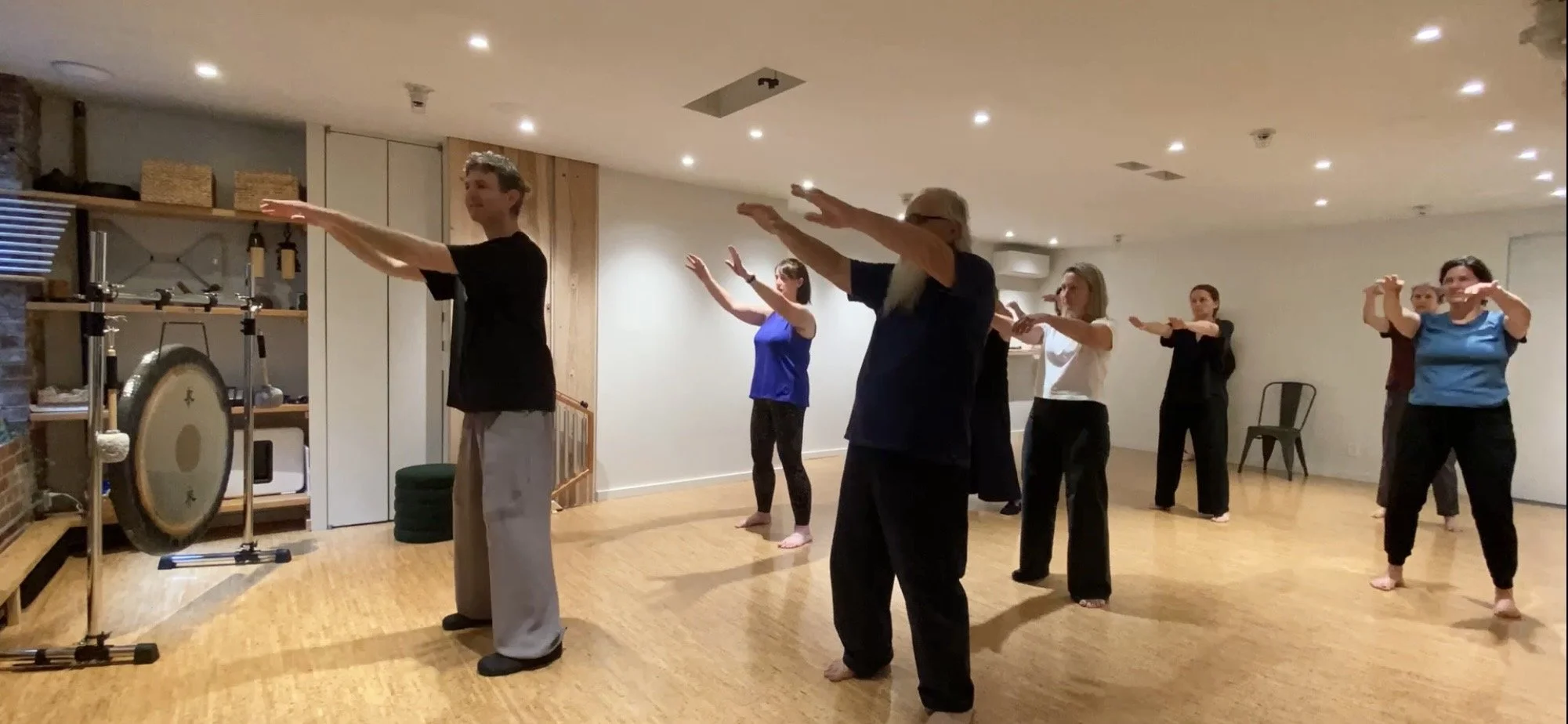
In the classes I teach, we're not working toward a particular aesthetic outcome. We're working toward a body that can keep finding its own center, appropriately firm where it needs to be and appropriately yielding where it needs to be, able to breathe fully, stand rooted, and move without fighting itself.
For the tight person, this often means learning to let go of effort they didn't know they were making, discovering that release isn't weakness but actually the precondition for real strength.
For the loose person, it often means developing an internal structure they didn't know was missing, finding that groundedness is available to them, it just had to be cultivated instead of forced.
In both cases the shift is real, it's felt in the body first, and it tends to carry well beyond just during training.
Whether you're locked up or too loose, whether it's your back, your neck, your nervous system, or some combination that doesn't have a clean name, these practices were built for exactly this work. They are old, they are specific, and they meet the body where it is instead of where you wish it was.
If you want to start exploring that, class is a good place to start, and private sessions let us go deeper into what's specific to your situation.
Jonathan Breshin is the founder of Root of Movement Internal Arts, a decade old school teaching Ba Gua Zhang, Qi Gong, Tai Chi and Nei Gong in New York City. He trained under Tom Bisio and is a soon to be licensed acupuncturist. Root of Movement classes are held weekly in NYC.